Warning: opendir(/home/gwadmin/public_html/images/stories/Saturday/20100320) [function.opendir]: failed to open dir: No such file or directory in /home/gwadmin/public_html/plugins/content/jwsig.php on line 100
2010 Classes (39)
The session on wooden brainteaser puzzles was a spin off from the class held several weeks ago on scroll saw and band saw toys. Karl Taylor did a great job describing a number of different puzzles he has made. These puzzles work off centrifugal force, magnets, mechanical catches, etc. Steve Mellott, Mike Peace and Buice Maday also brought various puzzles that they had made. Lots of great ideas for Christmas and challenges for future projects.
The December 4 class with Alan Noel was great! During his presentation, Alan discussed the types of finishes, how to apply them and answered any questions that members could ask. Before the presentation, the group was treated to one of the better Show and Tells. These items included bird house ornaments that had been turned on a lathe and then dyed, several boxes, some great scroll sawn items, and several segmented end grain cutting boards.
Member Demonstrations - November 26/27, 2010
Written by AdministratorWow - what a great Grand Opening! Many GWA members conducted demonstrations on the midi lathe, scroll saw and Jack Morse's "monster lathe." Even more came to shop and lend their support. It was great seeing the demonstrators and especially gratifying to watch some members share tips with other members who wanted to learn how to use the lathe and the scroll saw. We also spoke to several individuals who might be interested in joining our Club. Thanks again.
Shaker Boxes and Kitchen Spatulas - November 20, 2010
Written by Steven MellottLarry Ellison, the General Manager at Hardwoods Inc, gave a great demonstration on how to steam bend narrow strips of wood. He then proceeded to make a shaker box and several kitchen spatulas. Larry was very generous with his time and knowledge. He invited members of the club to copy his patterns and shared much information about these interesting projects.
Scroll Saw and Band Saw Toys - November 13, 2010
Written by AdministratorWow! What a class. Multiple members brought in samples of toys that were made on either a scroll saw or band saw. There had to be approximately 50 different projects presented during the Show and Tell. Diane Nistler, Karl Taylor, George North and Hans Meier then demonstrated how they actually made some of the toys. We also learned that there is a bit of child in each of us - several of the adult members had a great time playing with several of the toys. As a result of this learning, GWA will be scheduling a class on "brainteaser puzzles."
During the class, Steve Mellott also presented a Certificate of Appreciation to R.B "Smitty" Highsmith for his contributions to the Portrait Freedom Project. "Smitty" has cut more than 60 scroll saw portraits of military personnel who have been killed in action during the past several years.
Veterans Day Celebration - November 6, 2010
Written by AdministratorSteve Mellott announced the Veterans Day celebration is intended to be an annual event rather than a 1 time occurrence. The celebration included verbal comments as well as two brief videos. Highlights are as follows:
1. All GWA members were asked to identify themselves and were offered thanks for their service to our Country. As a lasting reminder of our gratitude, GWA memberws who are veterans will receive a $5 discount on all future renewal dues.
2. If a GWA member has a son, daughter or spouse serving in the active military, that dependent will be eligible to receive a GWA Certificate of Appreciation, a hand turned pen, a hand turned mug and a wooden Blue Star plaque. If you have a dependent who qualifies, please let us know. Also, if you'd like to help turn the pens, turn the mugs or make the plaques, let us know that as well. The same program pertains to GWA members who go into active service.
3. GWA presented a Certificate of Appreciation to R.B. "Smitty" Highsmith for his involvement in the Portrait Freedom Project. A copy of this award will also be placed in the Peachtree Woodworking class room.
4. Cake and coffe was served at the conclusion of the celebration.
5. Butch Davis, Wayne Martin and George North displayed their projects that won awards at the 2010 Georgia National Fair.
Steve Mellott begin this class by discussing dust collection theory as well as system selection, layout, installation and operation. Then Bob Aldea, John Eaton, Ron Harvey, and Wayne Mullins described the systems they have installed in their shops. (Home-Made, Grizzley, Oneida and ClearVue). Each discussed the benefits and limitations of their respective systems. It was interesting to hear both the theory and the real world experience. A special thanks to Peachtree Woodworking for providing Halloween cookies and to Mike Maples for giving away several boxes of woodworking magazines.
Last Saturday, Alex from Carter Products conducted 3 different bandsaw demos for the GWA membership. These are the 3 educational workshops he plans to conduct on the Woodworking Show circuit this year. GWA members received a lot of great technical knowledge and Alex received some great feedback regarding the presentation format and content.
On Saturday, October 9, GWA members toured 3 different shops in the Suwanee area. Although each was focused on woodworking, they were quite different in nature.
Bob Black's shop was filled with restored machines that were very old. I'm sure the "old arn" afficionados were extremely impressed. In my opinion, the centerpiece of the shop (literally and figuratively) was a 2200 pound 16" jointer restored in like-new condition.
Paul Proffitt's shop was a little smaller but it was filled with tools from today's modern era. I'm sure the woodworkers focused on today's modern technology were very impressed with Paul's shop - it even includes a laser engraver.
Ben Lloyd's shop included a number of different tools all lined up waiting to be used. Ben has also designed and built a number of enclosed cabinets to store his various hand-held tools and to protect them from the ever present dust in a woodworking shop.
There was really something for everyone on this shop tour. Thanks to Bob, Paul and Ben for opening their shops to the GWA membership.
In this Saturday's class Mark Barr talked about using routers and fixtures for routers. Mark uses a very simple router table as well as a simple fence. His router table is a piece of laminated MDF with a drop-in insert. The table is just supported by a couple of saw horses. For a fence Mark uses a straight piece of hardwood which is held to the table by a couple of clamps. He typically adjusts his fence settings by trail and error. That is he sets it close to what he wants then runs a test piece through.If that is not right, he then moves one end of the fence by loosening one of the clamps and uses a block of wood to tap the fence in the direction that he wants. He will draw a pencil line on the table top as a reference to help judge how far the fence was moved.
Mark also showed to class how to construct table legs by bandsawing a rough form and then using a template and a trim bit to get the final shape. He then showed how to form the dovetails in a table pedestal and how to cut the matching tendon on all of the legs. This is again done without using any type of measuring device.
Finally Mark showed his finger joint jig and how to set it up on the router table. He then cut some finger joints in some scrap pieces and showed how to adjust that device.
Gerald Jones, President GWA (but not much longer!)
Ken Vickery showed the group how to set up and use the Incra jig to create finger joints, dove tail joints as well as double joints for boxes. In case you are not familar with the double joints that is where there are two different woods are used in the same joint. Usually contrasting woods like walnut and maple are used for these double joints to make them stand out. Although Ken concentrated on joints for small boxes, he pointed out that there are several other uses for this jig. Ken showed a book holder and a business card case which he had made.
Gerald Jones, President
Segmented Turning by Don Russell - August 7, 2010
Written by AdministratorDon Russell talked to the group about creating segmented objects used different woods to make a pattern of some sort. The process generally consists of creating small pieces and then glueing them together to create a pattern. The basic pattern is often repeated in creative ways to produce items such as a table top or inlays for storage chest or boxes. This process is also used to produce segmented blocks for turning bowls, Christmas ornaments or candle sticks. In fact Don returned for the following Thursday meeting on the Woodturning group Don showed that group how to produce segmented turnings.
Gerald Jones, President
Devan Steen presented his first GWA class today. A recent high school graduate, Devan has joined the USAF and is waiting for orders to report. Devan spends his time working at Peachtree Woodworking Supply and learning more woodworking skills. He and his father are also restoring a 1968 Camaro.
Devan was eager to present a class as a way of saying thank you to the other GWA members for helping him learn woodworking. Today Devan presented an overview into the many different ways a drillpress can be used. He also covered setup and maintenance. There was however, a larger lesson learned. Devan showed us all that you don't need years of experience to contribute to the GWA, just a desire to learn and give back. Thanks Devan!
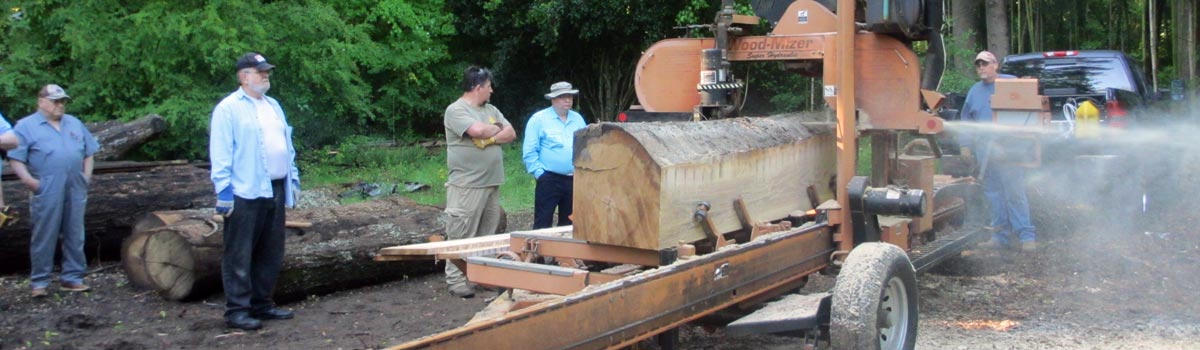
On this Saturday the GWA gathered at Louis Alexander's home (really a mini farm) in Lilburn to observe the milling of logs into lumber with a Wood Mizer band saw mill. First we were amazed that anyone would have that large of a track on land close to downtown Lilburn. But after driving way back into the woods behind the home we found Rick Clark who is the owner of Wood Genesis from McDonough all set up to cut lumber with his band saw mill. Louis had collected several logs for Rick to cut up. First up was a popular which was cut into smaller boards for use as sides and backs on cabinet drawers. After Rick made short work of that log, the wood was stacked to dry under a shed. Then Louis dragged up a red maple log which Rick started on next. Rick first cut some slabs off of the log. After turning those slabs over and looking at the grain pattern, the woodturners that were present promptly pulled them off to one side and cut several chunks off with a chain saw for turning pieces.
Gerald Jones, President
In Saturday's class, Sherman showed the group how he constructed a quarter scale model of a Conestoga wagon. Although the wagon model was built from plans there were several items that Sherman had to figure out on his own. He also had a problem finding some of the necessary hardware. All in all it was a challenging project. Now all he has to do is figure out where to display it in his house.
Gerald Jones, President
Tommy Roland did his usual through job of describing to Saturday's gathering how he builds his vaneered boxes. In fact, he had enough material that he could have used the entire day rather than a little over an hour. The club may well schedule a longer class from Tommy to go into more detail for those who are interested. Keep tuned as they say.
If you have not seen one of his vaneered boxes before they are truly works of art. Although Tommy goes about the process more like a metal worker than a woodworker. In case you don't know Tommy is also a metal worker and is as precise in his measurements as Ken Vickery. Well almost, Tommy works in 64s (0.0156) with wood rather than thousands of a inch (0.001 also know within the club as 1 KV). Seriously though Tommy's boxes are good enough that he has won several awards.
Gerald Jones, President
Placing Your Woodwork In Galleries - June 12, 2010
Written by AdministratorOn this Saturday Gary Gardner from Turning Leaf Wood Art Gallery in Blue Ridge, GA gave us a presentation. Go to see www.turningleafwoodart.com for some of Gary's work as well as other artist that he represents in his gallery. Gary talked to the members present about how to get your work into a gallery. Then he stayed around after the regular membership meeting for the Woodturning SIG meeting. For this meeting he talked about sharpening woodturning tools. Gary did not leave until almost noon that day. We appreciate Gary coming to Atlanta and giving us that much of his time.
In the first part of his presentation, Gary discuused art galleries and the accepted procedure for getting you work displayed in a gallery. He first mentioned that you have to go about it in a professional way. You need a portfolio showing your typical work and you also need to contact the gallery owner in advance to set up a convenient time to meet and discuss your work. In particular, he mentioned mulitiple times "Do not show up on a Saturday and try to talk to the gallery owner at that time. They are typically very busy at that time and can not talk to you." Another reason for contacting the owner in advance to schedule an appointment is that they are often traveling to visit other galleries and looking or visiting nationally known artists.
Gary went on to talk about a typical contract with a gallery and the split between the gallery and the artist. He further discussed some of the other issues involved in displaying your work in a gallery. He also talked about the liability issues and who gets stuck with the bill if an item is damaged or the gallery is destroyed by fire or some other natural disaster. I will not go into these issues because there is not enough space here to do that.
In the second part of his presentation after the regular membership meeting, Gary talked to the Woodturners about sharpening bowl gouges, spindle gouges and skews. As part of this he discussed grinders, grinding wheels and sharpening jigs. Gary mention that he almost always uses a jig for sharpening. It just easier to set up and maintain the same profile on a tool that way. There are only a couple tools that Gary sharpens free hand. He also talked about the various gouge profiles that various turners like. The most common one being the fingernail grind. He also mentioned how to tell if a tool is sharp or not. Do not use your thumb nail or try to shave the hair from your arm as a test of sharpness! What you should do is to look at the cutting edge under a direct incandesent light. If there are any reflections from the cutting edge then the tool is not sharp yet. So go back to sharpening until there are no reflections from the cutting edge. This check also works for other wood cutting tools such as plane irons, chisels and carving tools.
Gerald Jones, President
Steve Young from Franklin Inc. gave a presentation to the attendees on types of glues and their uses. He spent most of the time discussing the history of the development TiteBond Type I, II and III and why you would use one versus the other. Steve also talked about other glues produced by Franklin such as polyurethane and CA glues.
Gerald Jones, President
On Saturday, May 22nd, John Eaton showed the group what was on the GWA website and how to find it. This was an enlightening experience for some of the members who had not fully explored the site. Then after the regular class the first meeting of the renewed Computer Special Interest Group (SIG) met to discuss topics of interest to members that wanted to be part of that group. This discussion was led by John Eaton also. The discussion about woodworking software centered around mainly SketchUp and Delta CAD. There was also some discussion about woodworking websites but by far most of the discussion centered around tools for cleaning up your computer to make it run better and advoiding computer bugs. In the future, this group will meet once a month on the third Saturday immediately after the regular membership meeting.
Gerald Jones
President
Guilding by Sonny Franks - May 8, 2010
On Saturday, Sonny Franks showed the group how to add some pop to your woodworking projects by the use of guilding. Although other metal alloys such as silver, copper or mixes of silver, gold and copper, can be used for guilding, Sonny uses gold leaf for most in his work. Sonny works primarily with signs and uses gold leaf guilding to emphasize certain aspects of his signs but this process works on wood, ceramics and glass as well. Sonny showed us how to apply gold leaf to several wooden items. This process was often used in the past on furniture but has sort of fallen out of favor in the US. Although Sonny stated that it is still used extensively in Europe.
Sonny went through the entire process starting with applying the sizing which similar to varnish and letting that dry for the appropriate period. He then applied the gold leaf and burnished it to remove the excess. Sonny said that you could apply a clear coat over the gold leaf but it was not necessary. In fact he said the the clear coat would diminish the glitter of the gold leaf somewhat. There was a great deal of interest from the memebers that were present and they kept Sonny for quite a while after class asking questions.
Gerald Jones
President
Building a Dream by Thinking Small - April 24, 2010
Written by AdministratorRaised Panel Doors using a Table Saw - April 17, 2010
Written by AdministratorRicky Alexander demonstrated how to cut rails and stile as well as raised panels on a table saw. Although this is often done on a router table, Ricky showed that it can be done with a table saw. He first demonstrated how to cut the rails and stiles and then how to cut the raised panel. He first cut a of raised panel with a cove type of edge and then he cut panel with a tapered edge.
Mark Sillay - Turner and Wood Supplier - April 10, 2010
Written by AdministratorThe club visited Mark Sillay's shop in Stone Mountain on April 10th. Mark's Shop is in a commercial building just off of highway 78. Mark has several lathes (Jets and Powermatics) and is very active in wood turning. He teaches turning classes as well as sells his pieces. One of the most fascinating things about his shop is the amount of wood around the shop. There is a hugh amount of exotic wood in storage bins in a warehouse behind his shop. A large amount of this wood is imported from Australia . However, Mark has a equally huge pile of logs outdoors behind the warehouse. Everything from ambrosia maple to walnut. Mark gave an excellent demonstration on using a chain saw to cut blanks out of logs. He also talked a lot about reading a log to determine the best way to cut out a bowl blank with the best grain pattern. He proceeded to cut a piece of walnut crotch to show the grain pattern inside. Mark then cut up a piece of box elder to show the typical colored pattern inside. Finally Mark cut off a section of ambrosia maple and took it back into the shop and turned an end grain bowl from it.
On Saturday Bob Brokaw demonstrated his veneering technique. He showed how to cut a sheet of veneer and apply it to a board. Bob used his vacuum press to hold the veneer in place until it cured. Bob also discussed how to construct a vacuum press like to one featured on www.joewoodworker.com . Bob's vaccum press cost a significant amount for the parts which he got as a kit from the joewoodworker website. Bob mentioned that are many other uses for a vaccum system such as clamping parts to a workbench or for a vacuum chuck on a lathe. It was also pointed out by several members in attendance that there are many other sources for vaccum pumps as well as the other parts.
Please see the board notice in the last picture concerning the Huthmaker Violin shop in Duluth that is looking for someone to make a display stand for the shop.
On this past Saturday, Ed Sallee talked about building humidors for storing cigars. The function of a humidor is to maintain a humidity of 65-70% to keep the cigars from drying out. A humidor is basically a cedar lined box but it must be relatively air tight to maintain the correct humidity inside. Most humidors are lined with spanish cedar which is fairly dimensionally stable under these conditions. Even though Ed has only been doing this for a little over two years, he has developed a national reputation for his humidors. Ed gets orders from all over the US, Canada and has had some shipped overseas.
We traveled to the Gainesville area for today's shop tours. Each week some of our most dedicated members make the long drive to our meetings in Gwinnett and today we had the chance to return the favor. Each of the three shops today had it's own character and presented a different view of woodworking.
My first stop was at Don Bedell's shop, I knew he would have fresh donuts. I tried to be first in the door, but Bob and Rob beat me in! Don has a rustic shop on a main road just far enough away from all the new development in the area. His doors open to the busy highway just a few feet away. It has a look that makes you want to stop and explore. As you enter, the hours of operation sign gives you an idea of the kind of guy Don is. Inside it's much like you expect it to be, the wood stove, a large home made lathe and an appropriate amount of sawdust. Then the unexpected, a modern motorized Legacy mill next to an old fashioned wood bed Conover lathe.
My next stop was Dirk's, I've known Dirk for a long time, but this was my first visit to his new shop. Dirk is a quiet tech oriented guy and his new shop reflects it. The shop is located in a new industrial area on a quiet cul de sac. Entering the new commercial building you are welcomed into his bright and well appointed office. The shop itself is clean and spacious with two overhead doors and 3 phase electric powering his CNC. In the front corner is where the Dirk I know spends his time, the mad scientist laboratory. Around a large wooden desk with a computer, an electronic control box with all of it's internals exposed and a couple extra circuit boards are shelves filled with nuts, bolts. motors electronic components and a test bed CNC machine.
The last stop on my route was Corey's. Just as Don had told me, it was clean, ordered and well appointed. My surprise was that it was above his garage! Corey has a nice mix of new and old tools including a nice Craftsman table saw from the forties. I was really surprised to see that it had the original blade guard and splitter. The blade guard looked like it was from a saw made today. It just goes to show, some of today's ideas are not all that new. I was also impressed with the fact, Corey made his own cabinets and lathe bench.
Shop tours are a great way to get to know your fellow members. If you missed this one, make sure you attend the next.
Wayne Mullins has always been known for his bandsaw boxes and after the comprehensive presentation he gave today, it's apparent why they look so good. His class started with safety, basic saw setup and progressed through many different aspects of the way a bandsaw can be utilized.
Nearing the end of the alloted time it was obvious Wayne had barely scratched the surface. The over 60 members in attendance asked Wayne to continue and he agreed. After a short break the class progressed for another hour with Wayne answering questions and doing cutting demonstrations.
On Saturday March 6th, Judy Gale Roberts from Tennessee showed the group how she creates her "Intarsia". For those of you who don't know what intarsia is, the simplest description is 3D painting with various woods. the most common woods used by Judy are western red cedar, walnut and aspen. Judy pointed out to the group that western red cedar actually occurs in many shades from the almost white sap wood to nearly as dark as walnut for old growth heart wood.
Judy went through all of the steps to create a racoon in a tree which she uses to teach an imtermediate intarsia class. Words truly are not sufficient to describe her work. Be sure to visit her website for more examples of her pieces as well as plans that she produces.
Judy teaches a basic class, an intermediate class as well as an advanced class in her studios in Tennessee.
Gerald Jones
President
Marketing Your Work at Shows and Festivals - Feb. 27, 2010
Written by AdministratorIn this past Saturdays class Camille Ronay talked to us about selling your work at Shows and Festivals. Camille talked about what is important to focus on when trying to sell anything at these shows. For one thing she recommended thta you visit a particular show or festival before deciding to participate in it. She also discussed how important it is to display you items properly. Camille was so enthusiastic thae she talked non-stop for over an hour. Her husband Bill was going to provide more information about proper display techniques but there was no time left for him. Bill will return in the future but this class is yet to be scheduled so keep an eye out for it.
Gerald Jones
President
Documents provided by Camille Ronay as part of her class on Marketing Your Work at Shows and Festivals.
- The Creative Industries in Georgia - An eye opening overview on the 20,212 arts-related businesses in Georgia
- 2010 Well Attended Shows - A list of well attended shows around Atlanta with 2010 show dates.
- Georgia Made Georgia Grown, LLC Resources Links - A two page list of resources with online links to help get you connected.
In the Saturday class on February 20th, Wayne Martin showed the members how to turn with simple tools. Wayne does not have a scroll chuck or any fancy turning tools. He turned a candle stand between centers and a base for the stand with a face plate. Wayne emphasized that you do not have to have fancy tools and chucks to turn something nice. Wayne further emphasized that you do not have to purchased exotic woods because you can find what you need from your backyard or an adjacent woods.
Gerald Jones
President
On this past Saturday Ted Baldwin showed the group how to create gift items from laminated wood blanks. Ted makes many of his gift items from small pieces of scrap wood. Much like a scroll saw guru (George) he has never heard of wood scrap. As part of making these items Ted often uses either a radial arm saw or a chop saw. Ted showed us how to cut small items safely with a radial arm saw. Much the same principals work on a chop saw. Ted proceeded to cut some small earrings on the radial arm saw.
Gerald Jones
President
This past weekend, the regular membership meeting was not scheduled so that everyone could participate in the Wood Show at the North Atlanta Trade Center. I personally could not be there on Friday but I was told that there was a large crowd. I was there on both Saturday and Sunday and it was busy both days although apparently not as busy as Friday. We had demonstrations going on pretty much nonstop all three days and had a lot of people stop at the two booths and talk to us. There were a lot of nice complements on our demos and displays. We even had some of the vendors dropping by to look at what we were doing. Everyone that participated seemed to have a good time.
On Saturday January 23, Ralph Thorne demonstrated how to make a music box for a Valentine’s Day. Ralph started by making a top with a small rail and stile router bit set that was provided by Peachtree Woodworking. This was like making a cabinet door except that the rails and stiles were much smaller. The top had a panel insert and although the router bit set also had a raised panel bit in it, Ralph choose to use a flat panel for the top. Ralph pointed out that the panel was a flat piece of popular it could be decorated by silk screening or with a piece of marquetry. You could also use a piece of etched glass or stained glass for the top panel. Ralph used a router table to show how to cut the rails and stiles.
The Ralph showed how to make the box that the top went on. Ralph joined the sides of the box with rabbet joints at the corners. He cut the rabbits on the router table also. Ralph mentioned that the corners of the box could also be joined with mitered joints, finger joints or dovetails also.
Finally Ralph showed the group a trick for lining up the barrel hinges to join the top to the box. He used a precut piece wood that was the same length as the back of the box. He attached the piece to the box with double sided tape and then drilled the 5 mm holes for the hinge through this piece and into the back edge of the box. He then removed the drilled piece from the back edge of the box, flipped it over and attached it to the back edge of the top. This process assures that the holes in the box and the top are aligned properly.
Gerald Jones - President
Embellishing Your Work With Screen Printing
Written by AdministratorOn Saturday, January 16th, Gary Dean and Ralph Thorne talked about silk screening. Although the does not seem like a wood working topic, silk screening can be used to decorate wood items. Gary and ralph had some examples. Perhaps the most well known example was a bird house with “See Rock City” which was silk screened on to the roof. Gary discussed the process and showed how to make a frame and stretch the material across the bottom of the frame. The screen must then be coated with a light sensitive emulsion in a darkened room. The pattern is printed in black on a clear vinyl sheet which is then placed onto the emulsion coated screen. Usually a piece of glass is placed over the top of the pattern to hold it in place and then the screen is exposed to light which sets the parts of the emulsion that is not covered by the pattern. After the emulsion is set the glass and the pattern is removed the emulsion that is not set is washed away to form the pattern on the screen.
To use the pattern the screen is placed over the object to be ink is placed on one side of the frame. The ink is then drug across the screen with a squeegee which forces the ink through the pattern on to the object. Ralph showed the meeting attendees how this was done with an existing pattern that he had. He printed the image on to a board that had been painted a solid color.
Gerald Jones - President
On this past Saturday, January 9th, John Eaton talked about chisels. It may not seem like there is enough for an hour plus class on chisel but John was certainly up to the task. He talked about the various types of chisels and the distinctions between carpenters chisels and woodworking chisels. Basically a carpenter chisel has a larger working angle (40/45 degrees) due to the fact that carpenters are more interesting in removing relative large amounts of wood more quickly. These chisels are subjected to a significant amount of pounding. They also must withstand more abuse (not by good carpenters by the way).
Woodworking chisel have a finer cutting angle (25/30 degrees) since it is usually used for light chopping and shaving more than hogging out large amounts of wood. However this type of edge also requires more frequent sharpening.
John also discussed more unusual chisels such as “slicks” using by timber framers. These are still chisels but are much larger than the average woodworking chisels. He pointed out that not all chisel are straight and showed some offset chisels used to work inside of hollowed out regions. John went on to discuss carving chisels. Carving chisels have a large variety of shaped edges. Carving chisels can have shallow curves up to deep curves. This is generally referred to as the “sweep”. The carving chisel often have V shapes also.
John finished up by briefly discussing simple turning “chisels”. He pointed out that early turning tools were probably just modified chisels. Certainly the skew and the shallow gouge probably were modified chisels originally.
Gerald Jones - President
GWA Member Access
GWA Editor Login
Coming GWA Events
| Sat May 19 @ 8:00AM - 10:00AM Whirligigs and other animated designs with Wayne Martin |
| Sat May 26 @ 8:00AM - 05:00PM No class- Memorial Day |
| Mon Jun 04 @ 7:00PM - 09:00PM Snakes, Chains, Ball in a Box and Etc. |
| Sat Jun 09 @ 8:00AM - 10:00AM Shop Tours / Virtual Tours |
| Thu Jun 14 @ 7:00PM - 09:00PM 2012 Jun - Rob Austin & Jimmy Stripling - Pens and Christmas Ornaments |